The animation industry in the Philippines has long been marked by both opportunities and challenges. Animated works have been produced as early as the 1970s, with Tadhana (1978) being the first full-length animated film. In the 1980s, the Philippine animation industry was largely dominated by subcontracted labor, primarily consisting of commissions from studios abroad. Although original works were also being produced, many Filipino animators struggled to create their own projects due to challenges in funding. In recent years, however, times have changed. More opportunities have emerged, paving the way for an increasing number of original works.
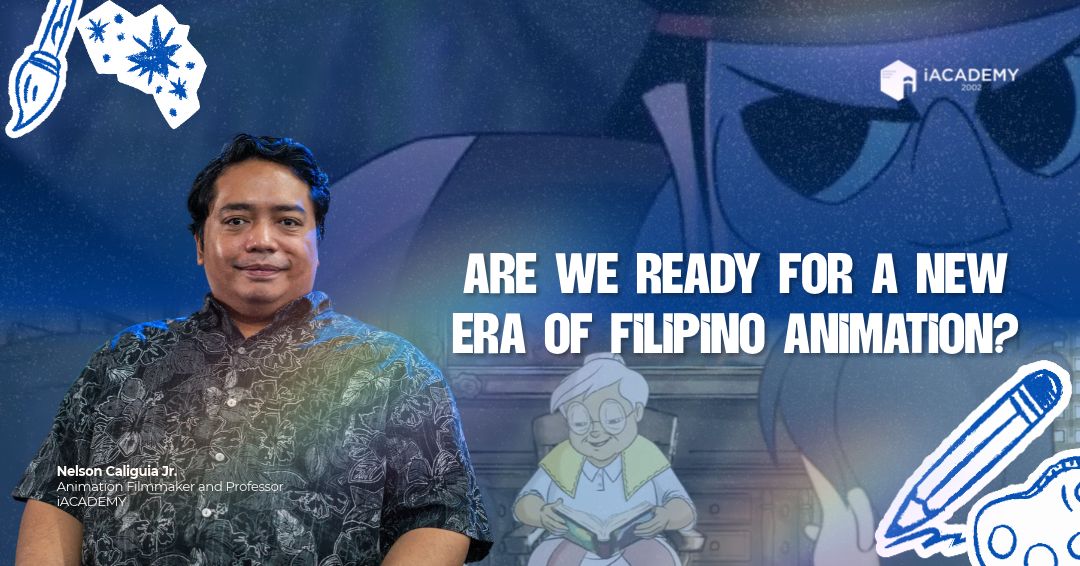
One of the notable figures making waves in the industry is iACADEMY’s very own animation professor, Mr. Nelson Caliguia Jr. He is the creative mind behind Sulayman (2023) and Mga Kwento ni Lola Basyang (2024). He shared that he was born into the world of animation, following in the footsteps of his father, Mr. Nelson Caliguia Sr., one of the pioneers of Filipino animation. Growing up, Prof. Nelson drew inspiration from his father and other artists. In particular, his love for animation was sparked by the Disney renaissance and the anime boom of the 1990s, both of which made up his artistic influences.
According to Prof. Nelson, “During the late 90s and early 2000s, making your own animation here in the Philippines feels like you’re a voice in the wilderness." At the time, animators were largely left to their own devices. However, times are changing, and Prof. Nelson has taken notes of the recent developments in the industry. He observed that the community is steadily growing. “We are in an exciting time,” he said, referring to the increasing number of animated works being produced. There are not plenty of Filipino animators and filmmakers whose works serve as inspiration for others. Among those he mentioned were Luis Suarez, the mind behind RPG Metanoia (2010); Avid Liongoren, whose works include Saving Sally (2016) and Hayop Ka! (2020); and Mervin Malonzo, director of Ella Arcangel: Ballad of Tooth and Claw (2026). To Prof. Nelson, animation is no longer a niche interest in the country but is steadily making its way into the mainstream.
To bridge the gap between the Philippine animation industry and its international counterparts, we need to keep the momentum going. To Prof. Nelson, it would be great to take inspiration from what our Southeast Asian neighbors are doing. He cited Indonesia as an example, noting that the country releases one animated film per year. If the Philippines could find a way to match this rate of production, it would be a significant step forward for the local industry. Another key ingredient to success, he added, is for Filipino animators to embrace themselves and let their identities shine through their work. “Find your own voice,” Prof. Nelson advised.
There has also been more generous government support through grants. Another positive development is the advancement of technology. Today, various apps and hardwares allow animators to produce complex animations with a limited budget.
Contributing to these developments in the animation industry is iACADEMY. According to Prof. Nelson, “iACADEMY is one of the best animation schools to go through in the Philippines. [...] I do believe that it is one of the best options if you want to study animation in the Philippines. First and foremost, I think the roster of professors are of a really good calibre. […] And having the tools that iACADEMY has, having the laboratories, I think is also really important because, again, animation is always interconnected with technology. So having access to that kind of technology is really, really important, and iACADEMY certainly has those tools and equipments.” And it is because iACADEMY is committed to equipping students with the tools and knowledge relevant to the animation industry that students are able to produce original and award-winning works such as Lysa Catolico and Jazmine Pateña’s Runo!, which won Best Screenplay at Cinemalaya 2026, among many other notable student productions.
With all these exciting developments in the Philippine animation industry, it will be interesting to see what the future holds, and how iACADEMY will continue to contribute to its growth.